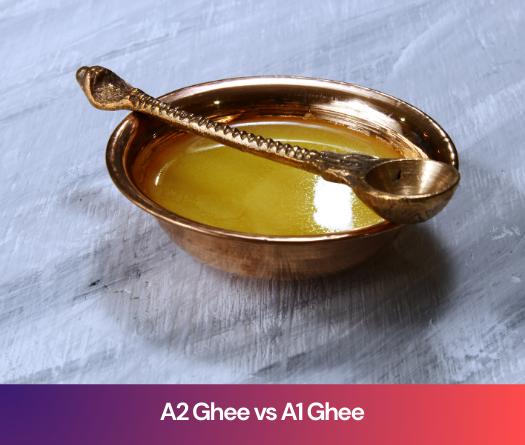
A2 Ghee vs A1 Ghee: What You Should Know Before Choosing Your Daily Fat
A2 Ghee vs A1 Ghee explained simply. Learn the key differences, ...

A2 Ghee vs A1 Ghee explained simply. Learn the key differences, health impact, and why Murli amrit ghee matters for digestion.
Walk into any grocery store today and you’ll see shelves full of ghee. But not all ghee works the same inside your body.
The real difference doesn’t start in the kitchen. It starts with the cow.
The conversation around A2 ghee vs A1 ghee isn’t marketing hype. It’s about digestion, inflammation, and how modern food systems changed something that was once simple.
In this article, we’ll break down:
Let’s keep this practical, honest, and useful.
The core difference lies in milk protein, not fat.
Milk contains beta-casein protein, which comes in two main types:
A2 ghee is made from milk of indigenous Indian cow breeds like Gir, Sahiwal, and Red Sindhi.
A1 ghee comes from milk of crossbred or foreign breeds like Holstein Friesian.
Why this matters:
Stat 1:
Research shows BCM-7 is linked to digestive discomfort and inflammatory responses in some individuals.
Since ghee is derived from milk, the protein profile of the original milk still influences how the body responds to it.
Digestion is where most people feel the difference first.
Many people report bloating, heaviness, or acidity after consuming regular ghee or dairy. Often, the issue isn’t fat itself. It’s protein sensitivity.
A2 ghee is generally:
A1 ghee, on the other hand, may:
Stat 2:
Digestive sensitivity affects nearly 35–40% of adults, according to global gut health studies.
This is why many people feel lighter after switching to A2 ghee, even when quantity stays the same.
Food doesn’t just fuel the body. It communicates with it.
BCM-7, released during A1 protein digestion, has been studied for its potential inflammatory role.
Stat 3:
Some studies associate BCM-7 with increased inflammatory markers, while A2 protein shows a neutral response.
A2 ghee supports:
This matters long term, especially for people dealing with:
Traditionally prepared ghee like Murli amrit ghee aligns better with these needs because it avoids heavy processing and preserves natural fat structure.
Beyond digestion, cooking safety matters.
Ghee is widely used because it handles heat better than most oils.
Stat 4:
Ghee has a smoke point of around 250°C, higher than butter and many refined oils.
A2 ghee advantages:
A1 ghee may still work for cooking, but quality varies depending on:
Traditional methods retain nutrients more effectively than industrial extraction.
Consider someone experiencing:
They make one change:
Over a few weeks, common outcomes include:
The diet didn’t become fancy. It became familiar to the body again.
That’s often the missing link.
If you’re deciding, keep these points in mind:
Quality matters more than quantity. This is where trusted options like Murli amrit ghee make a difference.
The difference between A2 ghee and A1 ghee isn’t about trends. It’s about compatibility.
A2 ghee aligns better with digestion, gut comfort, and long-term balance, especially for Indian diets. A1 ghee may work for some, but for many, it adds silent strain.
If you’re choosing a daily fat, choose the one your body understands.
Sometimes, the old way really is the smarter way.
1. Is A2 ghee better than A1 ghee?
For digestion and tolerance, A2 ghee is generally better.
2. Can lactose-intolerant people consume A2 ghee?
Yes, ghee contains negligible lactose.
3. Does A2 ghee help with acidity?
When used in moderation, it can soothe the gut lining.
4. Is Murli amrit ghee made from A2 milk?
Yes, it follows traditional sourcing and preparation.
5. How much ghee should I eat daily?
1–2 teaspoons is suitable for most adults.


