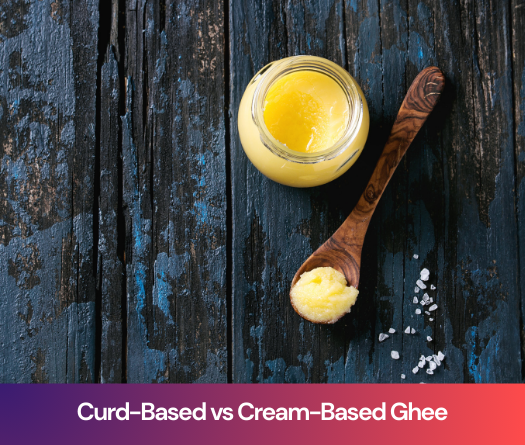
Curd-Based vs Cream-Based Ghee
Curd-Based vs Cream-Based Ghee explained. Learn how processing affects nutrition, digestion, ...

Curd-Based vs Cream-Based Ghee explained. Learn how processing affects nutrition, digestion, and why Murli amrit ghee follows tradition.
Most people judge ghee by its color, aroma, or price. Very few ask the most important question: How was this ghee made?
Behind every jar of ghee lies a process. And that process determines how your body responds to it. The two most common methods are curd-based ghee and cream-based ghee. On the surface, both look similar. Inside the body, they behave very differently.
Understanding the difference between Curd-Based vs Cream-Based Ghee can help you choose ghee that supports digestion, metabolism, and overall health. In this article, we’ll break down both methods, compare their nutritional impact, share real-life insights, and explain why traditionally prepared options like Murli amrit ghee matter.
Curd-based ghee follows the age-old Indian process, often called the Bilona method.
This method respects fermentation and time.
Traditional fermentation can reduce lactose content by up to 90%, making curd-based ghee gentler on sensitive stomachs.
This is the method followed by traditionally prepared brands like Murli amrit ghee, where digestion is prioritized over speed.
Cream-based ghee is produced for speed and volume.
This skips the curd and fermentation stage entirely.
Industrial dairy studies show that cream-based ghee may retain 2–3 times more milk residue compared to curd-based ghee, depending on filtration quality.
While cream-based ghee is cheaper and faster to produce, it often compromises digestibility.
Both types are fats, but the nutritional impact isn’t identical.
Curd-Based Ghee
Cream-Based Ghee
Research on fermented dairy fats shows 15–20% better fat absorption compared to non-fermented dairy fats.
Fermentation doesn’t change calories, but it changes how your body uses them.
This is where the difference becomes practical.
People who experience:
often tolerate curd-based ghee better.
Digestive studies indicate that traditionally fermented fats can reduce post-meal discomfort by 25–30% compared to non-fermented fats.
That’s why curd-based ghee is commonly recommended in Ayurveda for daily consumption.
Consider a family using cream-based ghee daily.
Common complaints:
They switch to curd-based ghee and make small changes:
Within weeks, they notice:
This isn’t about “more ghee.” It’s about better ghee.
Before choosing, look beyond the label.
Brands like Murli amrit ghee highlight traditional preparation because the process itself is the value.
The difference between Curd-Based vs Cream-Based Ghee isn’t just technical. It’s biological.
Curd-based ghee:
Cream-based ghee:
If ghee is part of your daily diet, the method matters more than the brand name. Choose ghee that respects time, fermentation, and digestion. Traditionally prepared options like Murli amrit ghee aren’t just food. They’re functional nutrition.
Yes, especially for digestion and daily use.
Negligible amounts due to fermentation and clarification.
It takes more time, milk, and manual effort.
Yes, but it may not suit sensitive digestion daily.
Yes. It follows traditional curd-based preparation.


